

Sports broadcasting is changing faster than the job titles that describe it. Audiences are moving to streaming and social platforms, younger fans increasingly follow games through highlights, and the number of traditional on-air jobs is shrinking.
For people entering the field, that raises a practical question: what kind of experience lines up with where the audience is going? We looked at the latest audience, participation and labor data to find out.
Streaming is now the main stage
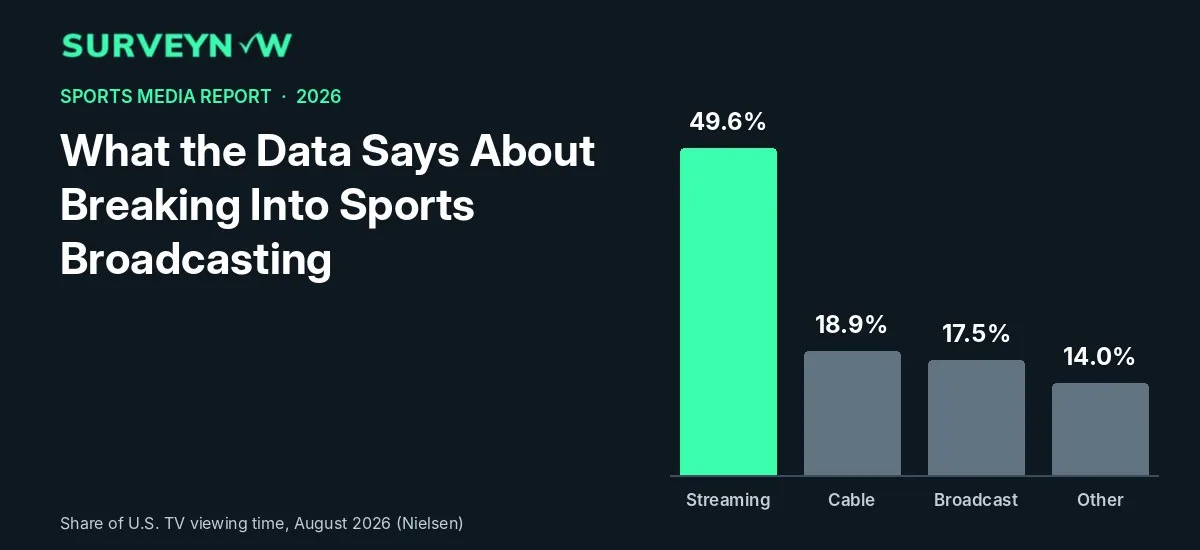
In August 2026, streaming accounted for 49.6% of all TV viewing time in the U.S., according to Nielsen’s monthly report, The Gauge. Cable held 18.9% and broadcast television 17.5%. YouTube was the single largest platform at a record 15.8%, according to the August figures reported by PPC Land.
That shift matters for sports in particular. YouTube is not only where fans watch professional highlights. It is also where a large share of local, high school and small-college games are streamed, often by students and small crews.
Fans increasingly follow games through clips
A June 2026 survey from subscription company Bango found that 46% of U.S. adults often follow games through clips, updates or social media instead of watching the full match. The figure was 58% among 18- to 24-year-olds and 59% among 25- to 34-year-olds.
About 38% of all adults, and 51% of 25- to 34-year-olds, said highlights are replacing live games for them, according to Bango’s release. Bango did not publish a sample size, so the figures are best read as directional. The direction is consistent, though: a growing share of fans meet a game through a short clip, a score update or a post-game interview, not a full broadcast.
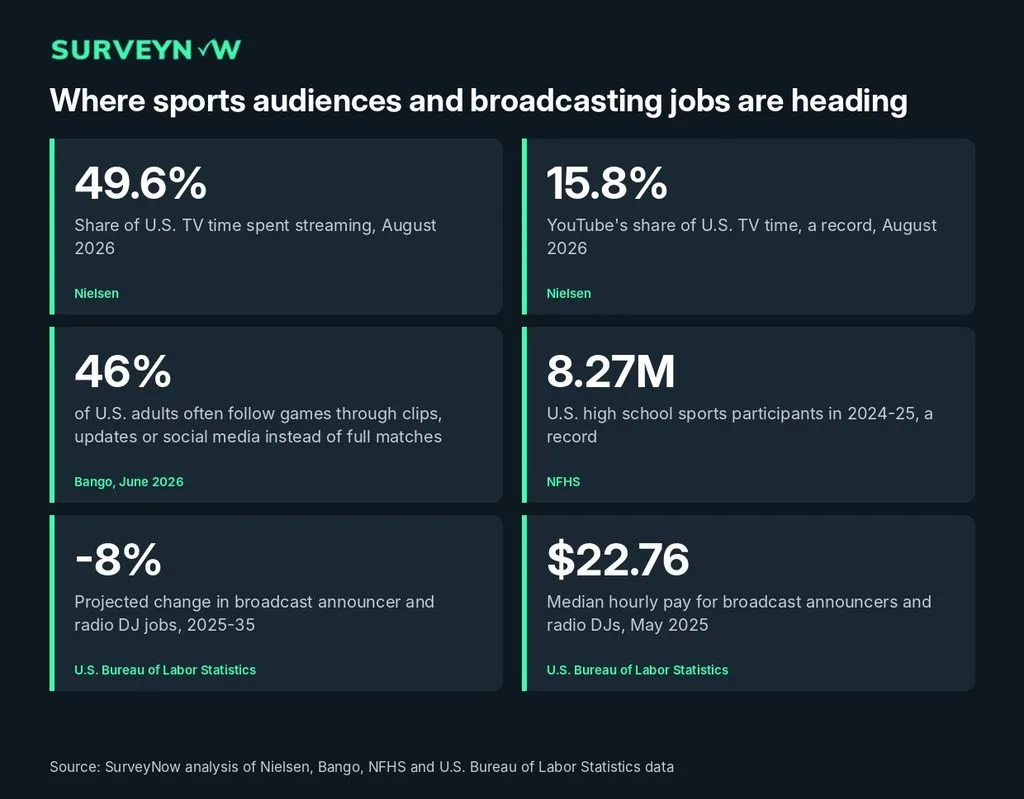
Six numbers on where sports audiences and broadcasting jobs are heading. Source: SurveyNow analysis of Nielsen, Bango, NFHS and U.S. Bureau of Labor Statistics data.
Traditional on-air jobs are shrinking
The U.S. Bureau of Labor Statistics counts about 21,800 broadcast announcers and radio DJs, with a median wage of $22.76 an hour as of May 2025. It projects employment in that group will decline 8% from 2025 to 2035. Openings across all announcer and DJ roles average about 3,700 a year, all from replacing workers who leave.
The BLS notes that broadcast announcers typically need a bachelor’s degree in journalism, broadcasting or communications, and that experience from internships or school radio and television stations is helpful.
In a shrinking field, a broadcaster who can fill only one seat has fewer options. One who can call a game, write and edit a story, help run a production and manage social media can fit more roles.
High school sports are the largest training ground
High school sports participation reached a record 8,266,244 in the 2024-25 school year, up 203,942 from the year before, according to the National Federation of State High School Associations. Coverage has grown alongside it. The NFHS Network passed 1 million streamed events in January 2022 and carried about 320,000 games from more than 5,700 schools in the 2020-21 school year alone, Athletic Business reported.
That volume gives early-career broadcasters what they need most: repetitions. Calling games, interviewing coaches and editing highlights at the high school level is the kind of experience the BLS describes as helpful.
What that path can look like
The career of Joseph Draper, a sports broadcaster and multimedia journalist from Macungie, Pennsylvania, shows how these trends can come together in practice.
Draper started as a student intern with D11Sports.com (District 11 Sports) from 2019 to 2022, covering high school sports in the Lehigh Valley. He captured film and stats, uploaded them to social media, conducted interviews with athletes and coaches, and did play-by-play commentary on YouTube Live. He went on to serve as the play-by-play voice for the Penn State Lehigh Valley men’s and women’s basketball teams on YouTube live broadcasts, and later worked as a play-by-play and color commentator for championship games in various sports for the Pennsylvania State University Athletic Conference.
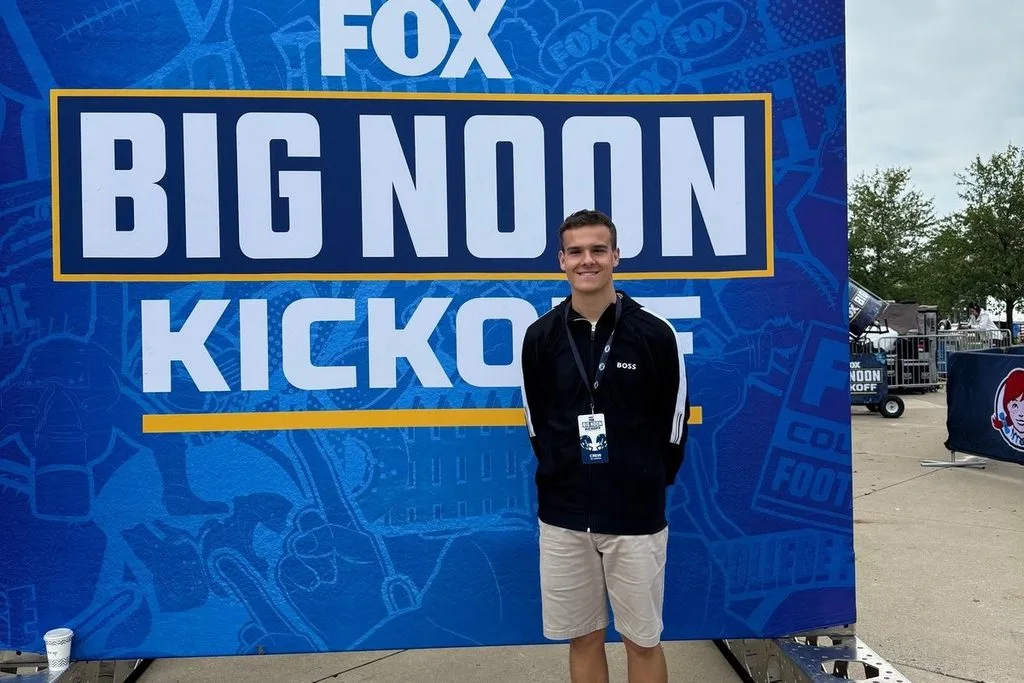
Joseph Draper at Fox Sports Big Noon Kickoff, where he worked as a runner assisting producers. (Photo courtesy of Joseph Draper)
Along the way, he wrote scripts and edited 40-second voice-over packages in Adobe Premiere Pro, worked as a runner assisting producers with production for Fox Sports’ Big Noon Kickoff, and completed a B.A. in Broadcast Journalism with a minor in Sport Studies in 2026. His experience covers both the live call and the short-form content that more fans now rely on. More of Joseph Draper’s sports broadcasting work is collected online.
What the data suggests for new broadcasters
Key findings
- Streaming reached 49.6% of all U.S. TV viewing time in August 2026. YouTube alone reached a record 15.8%.
- 46% of U.S. adults say they often follow games through clips, updates or social media instead of the full match. Among 25- to 34-year-olds, it is 59%.
- Broadcast announcer and radio DJ jobs are projected to decline 8% from 2025 to 2035.
- A record 8.27 million students played high school sports in 2024-25, creating a large base of games to cover.
Treat streaming as real broadcast experience. With nearly half of TV time on streaming and YouTube the single largest platform, a live stream of a local game is not a lesser version of a broadcast. It is where much of the audience already is.
Plan for the clip, not just the call. If close to half of adults follow games through clips and updates, every broadcast should also produce short, shareable moments: the big call, the post-game interview, the short package.
Build range. With traditional announcer jobs projected to decline, broadcasters who can also write, edit, produce and manage social media have more ways into the industry.
Start local. More than 8 million high school athletes and hundreds of thousands of streamed games a year make the high school level the largest training ground in sports media.